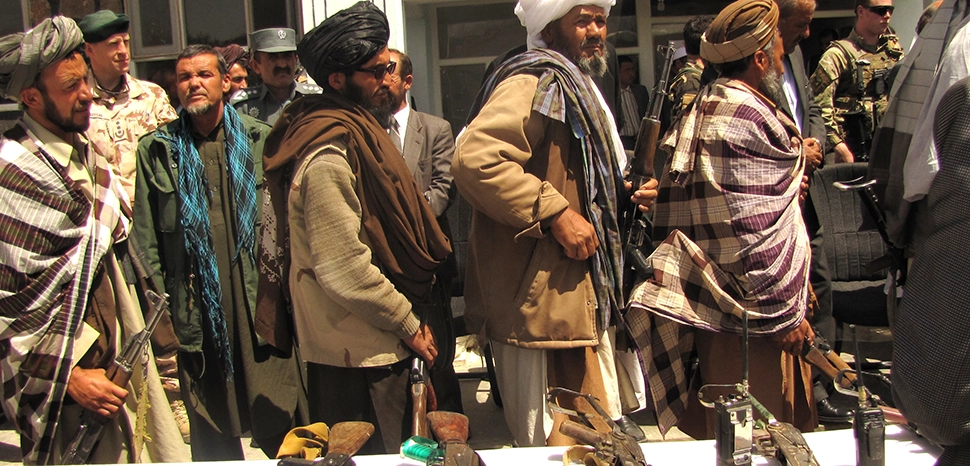
The rise of militant Islam in Pakistan ranks among countless examples of short-term political gain sacrificing long-term stability. In the 70s, the Zia government manipulated religious symbols in order to raise a holy army and shore up its own domestic support. However, after the war against Soviet occupation in Afghanistan ended, militant Islam could not be sealed away. Now in the year 2009, the Pakistani state is fighting for its survival against Islamic militias borne of the Taliban’s ideology.
The Rise of General Zia
The Pakistani state has always been tied to Islam. It is, after all, originally a homeland for the Muslims of colonial India. Up until the 1970s, Pakistan’s Islamic identity was able to co-exist relatively peacefully with secular politics. However, a coup in 1977 began a process that would eventually change the complexion of Islam in Pakistan, transforming it from a moderate interpretation to the militant version that is now rising to challenge the state.
In 1977, General Muhammad Zia-ul-Haq seized power in Islamabad, overthrowing the democratically elected government of Zulfikar Ali Bhutto. After taking power, General Zia, a staunch Islamist and anti-communist, found himself presiding over a government that had no constitutional mandate to rule [2]. Furthermore, large portions of the population continued to support the deposed President Bhutto and his Pakistani People’s Party (PPP).To overcome this deficit in popular support, General Zia adopted two strategies that still resonate in present day Pakistani politics: relying on the military to prop up his regime and the manipulation of Islamic symbols for political ends [1, 2].
The Mujahideen in Afghanistan
In 1978, a coup in Afghanistan brought the Soviet-backed People’s Democratic Party of Afghanistan (PDPA) into power. To the Zia government, the PDPA represented both an external threat from the Soviet Union as well as the potential for internal subversion from ethnic Balochs, Pashtuns living along the Durand line, and leftist PPP members [1]. In response to these threats, the Zia government began to organize and train disparate Afghan ethnic groups under the inclusive flag of Islam, a strategy that was facilitated by the ‘godless’ nature of the Soviet-backed PDPA regime. Before the Soviet invasion of Afghanistan had even occurred, several Mujahideen training camps existed in Pakistan [3]. Most of these camps were located in the Northwest Frontier Provinces (NWFP) and federally administered Tribal Areas (FATA), two regions where the present-day Taliban’s hold is strongest [1].
When the Soviets eventually invaded Afghanistan in 1979, Pakistan’s Inter-Services Intelligence (ISI) responded by intensifying efforts to organize Afghan partisans in Pakistani training camps [3]. The period from 1979-1989 was marked by the establishment of an intricate indoctrination and training system for Mujahideen fighters in Pakistan, lubricated by U.S. aid, and comprised of a network of madrassas and training camps situated along the Durand line and beyond [1, 2]. In the end, General Zia’s strategy of championing Islam to secure his shaky regime was successful, though it came at a cost of blurring the line between civilian and military rule and the creation of a network devoted to the propagation of radical Islam.
Pakistan Support for the Taliban in the Afghan Civil War
After the unifying symbol of the Soviet army withdrew from Afghanistan, the ethnic and religious groups that made up the Mujahideen began to fracture, eventually plunging Afghanistan into civil war. The Pakistani government’s patron of choice during this time came to be the Taliban. Their reasons were as follows: